
Oct 25, 2026Buying Guides
Gift Cards vs Physical Gifts for Employees: A Buyer's Comparison
Gift cards vs physical gifts for employees — the reach, cost, tax and culture trade-offs, when each form wins, and how to split the budget by program line.
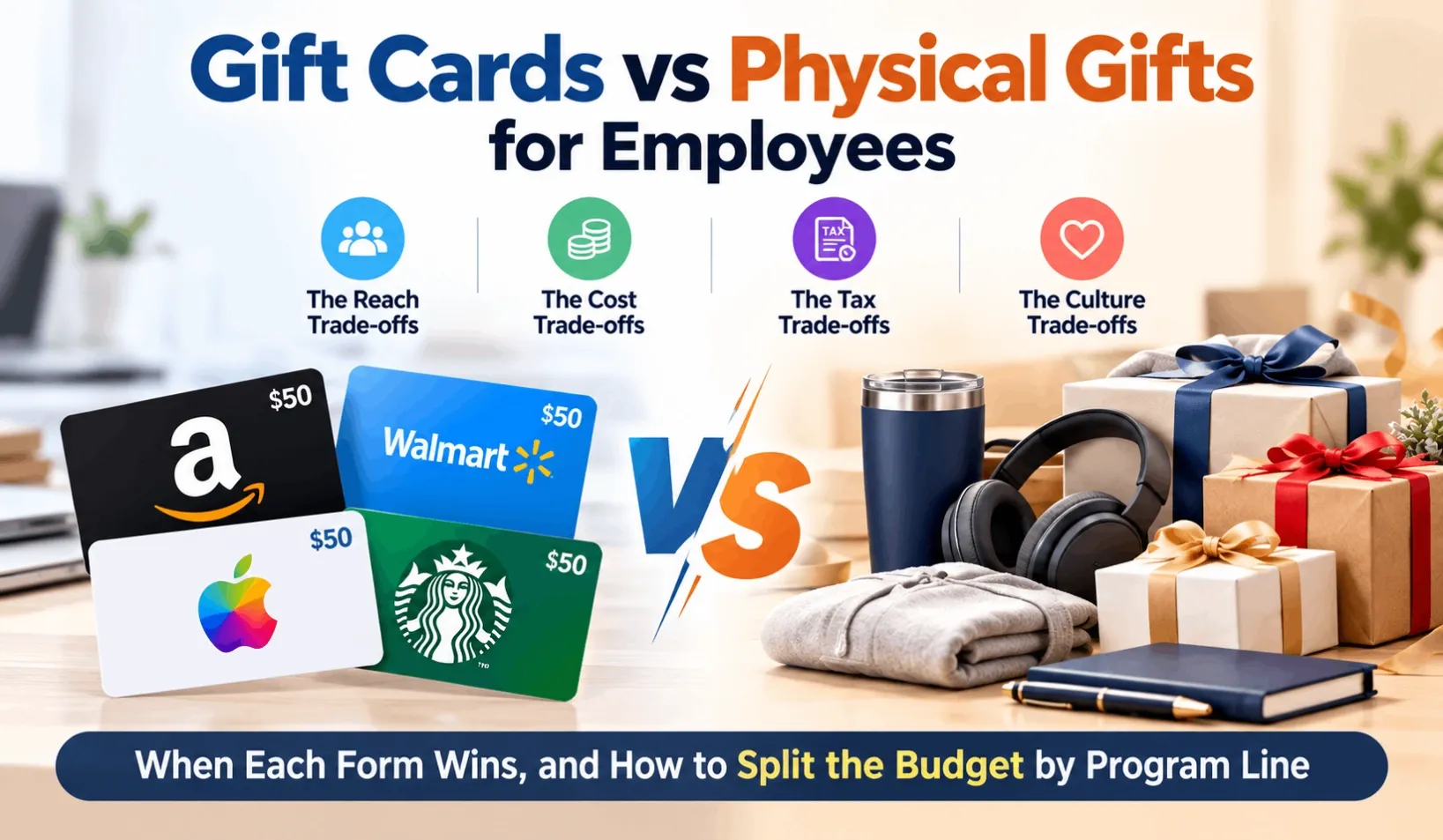
The gift cards vs physical gifts decision comes up in every employee gifting program, and it is usually framed as a preference question ("what do employees like more?"). It is actually an operations and strategy question: the two forms have different logistics, different costs, different tax treatment and different jobs to do — and the right answer is usually a mix, decided per program.
The short answer: gift cards win on reach and choice (remote employees, international teams, tight deadlines); physical gifts win on the culture moment, brand presence and the day-of experience. Budget the two separately, apply the same tax checks to both, and design the split by program — birthdays and holidays often mix, while recognition moments usually favour physical. For companies that source physical gifts from China, the volume economics of a batch order typically beat card face-value costs at meaningful headcounts — which is the comparison this guide walks through.
Why Is This a Real Procurement Decision?
Gift cards and physical gifts are often treated as equal options with different packaging. In practice they differ across the whole procurement life cycle:
Dimension | Gift Cards | Physical Gifts |
|---|---|---|
Reach | Anywhere with email; no address needed | Requires delivery logistics (office or home) |
Lead time | Same-day to days; no production | Weeks (production, personalization, freight) |
Per-unit cost | Face value; no volume discount at small scale | Volume tiers reduce unit cost meaningfully |
Brand moment | Minimal; the platform's interface | Strong; your brand on a physical object |
Choice | High; recipient picks exactly | Limited to the catalog (unless a choice set) |
Memorability | Low; fades quickly | High; the object persists |
Tax treatment | Often treated as cash equivalents — frequently taxable | Depends on value thresholds and jurisdiction |
The tax row deserves emphasis: in many jurisdictions gift cards are treated like cash for tax purposes, while physical gifts may qualify for de minimis exemptions. The treatment flips the "cheaper" calculation in ways the face value hides — check with your finance team per market before choosing the form for high volumes.
When Should You Choose Gift Cards?
Gift cards are the right tool when logistics dominate the decision:
- Remote and distributed teams. No addresses to chase, no parcels to deliver, no transit risk. This is the single strongest use case.
- International employees. Card platforms operate across markets where shipping physical gifts would trip over customs and duties; local-currency cards avoid the whole problem.
- Tight deadlines. A program that has run late can still be salvaged with digital delivery. Physical gifts cannot be conjured quickly.
- High variety of recipient circumstances. When the catalog cannot serve everyone (dietary restrictions, different cultures, different home situations), choice beats a standardized item.
The trade-off to accept: the moment is transactional. A gift card marks the occasion but does not create the physical culture artifact — the branded bottle on the desk, the notebook in the meeting — that keeps the brand present after the moment passes. Companies that want both often use cards as the fallback option rather than the primary program.
When Should You Choose Physical Gifts?
Physical gifts are the right tool when the moment and the culture signal dominate:
- Culture and recognition moments. Recognition must feel earned and visible — a physical award or gift set does that job; a card does not. Our recognition program guide covers the tiering logic.
- Milestones and achievements. Anniversaries, completed projects, service awards — the artifact persists as the record of the moment.
- Onboarding and welcome. A new hire's first physical object from the company anchors day one in a way no digital delivery does.
- When volume economics work. At meaningful quantities, a well-chosen physical item at volume-tier pricing can deliver more perceived value per dollar than a gift card of equal face value, because the production cost is below the item's perceived value — the same logic supermarkets use with own-brand goods.
The trade-off to accept: logistics. Physical gifts need lead time, addresses, delivery paths (and transit-grade packaging for home delivery) — the operational load covered in our welcome kit guide.
How Should You Split the Budget Between the Two?
Most well-run programs use both forms — not equally, but per program line. A working default:
Program | Primary Form | Rationale |
|---|---|---|
Holiday gifting | Physical, with cards as remote fallback | Cultural moment at scale; volume pricing works |
Recognition & milestones | Physical | Must feel earned and persist |
Birthdays | Physical where feasible; cards for remote | Frequent personal moment |
Onboarding | Physical | The first-object anchor |
Spot rewards | Cards | Speed matters; the moment is the manager's conversation |
International teams | Cards (or local fulfilment) | Customs and duty friction |
Two budgeting rules. First, model the true cost of each: physical gifts include production, personalization, packaging and freight; cards include face value plus platform fees (often 2–10% depending on provider and volume). Second, do not mix them in the same moment — a program where some employees receive a physical gift and others a card of "equivalent" value reads as inequality even when the intent is parity. Choose the form per cohort, not per person within a cohort.
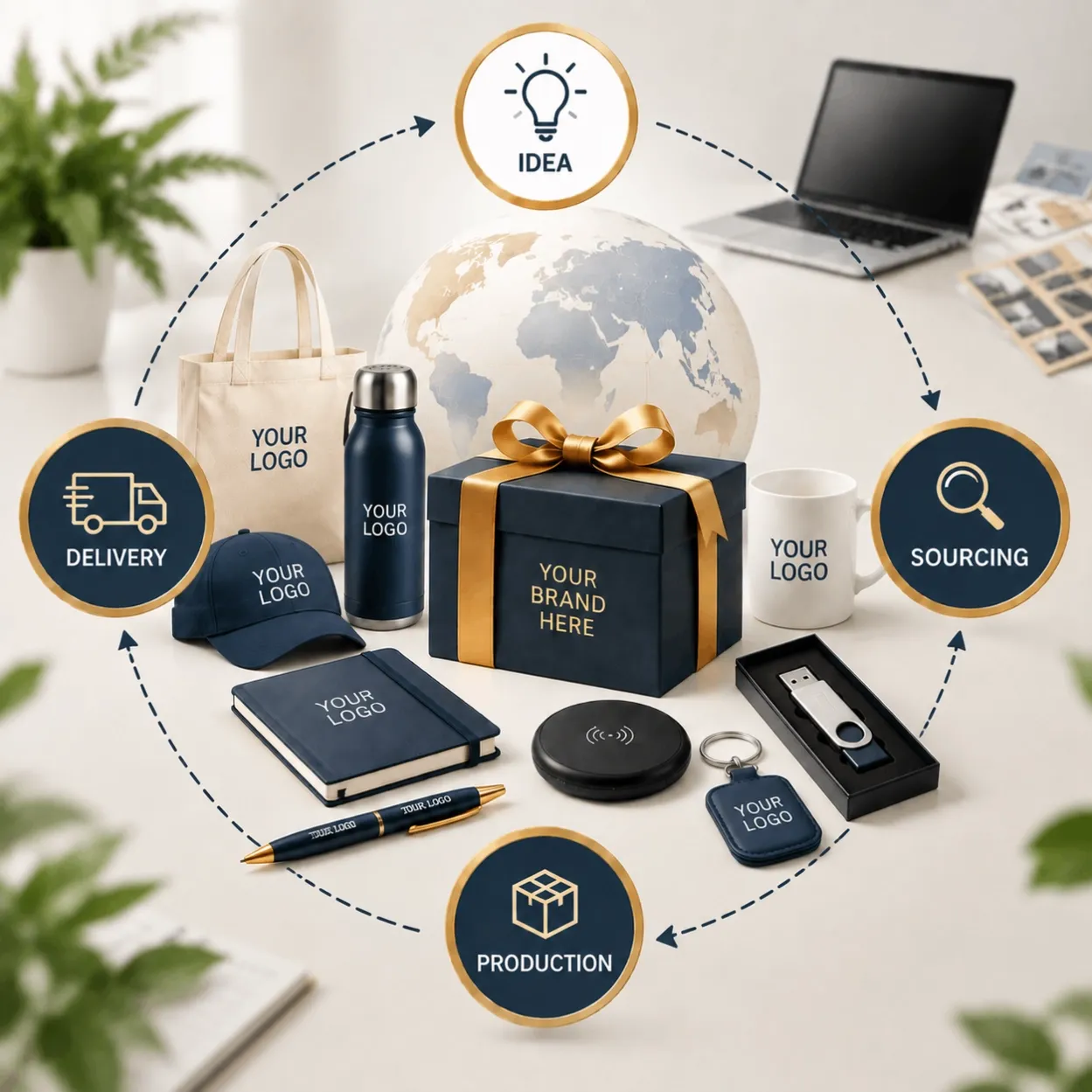
Physical gifts at volume tier pricing: the production cost curve is what makes a quality item affordable at program scale.
What Are the Tax and Compliance Differences?
This is where the two forms diverge most, and where the gaps between jurisdictions matter:
- Gift cards are frequently treated as cash. Many tax authorities classify gift cards and vouchers as cash equivalents, meaning their full value is taxable income to the employee in most cases — no de minimis exemption applies. At scale, that creates withholding and reporting work.
- Physical gifts are often exempt below thresholds. Commonly cited examples: the UK's £50 per-employee trivial-benefit exemption (which explicitly excludes cash and cash-like vouchers), Germany's €50 threshold for employee gifts, and US de minimis rules for branded items under $4 — with most other employee gifts treated as taxable wages.
- The exemption usually conditions on the form or the purpose. Some jurisdictions exempt achievement awards up to higher values than general gifts; others treat everything above a threshold as compensation regardless of form.
The working conclusion: at equal face value, a physical gift is more likely to stay exempt and to cost less overall once production is at volume tiers — which is why programs that care about total cost often favour physical for the largest cohorts. Our employee appreciation guide covers the threshold details per market.
What About Client Gift Cards?
The client side adds one more factor: gift cards are often restricted or prohibited by recipient organizations' gift policies — and in regulated industries or public-sector relationships, a card is more likely to be declined or to require disclosure than a modest physical gift. For client appreciation, physical gifts with light branding are the safer default; see our client appreciation guide for the compliance framework.
Frequently Asked Questions
Are gift cards better than physical gifts for employees?
Neither wins outright — they solve different problems. Gift cards win on reach, choice and speed (remote teams, international employees, tight deadlines); physical gifts win on the culture moment, brand presence and memorability (recognition, milestones, onboarding). Most programs use both: physical as the primary form for culture moments, cards as the fallback for logistics-bound cases. The tax treatment differs too, and in many jurisdictions cards are treated like cash.
What is the best gift card for employees?
The practical selection criteria: a platform with local-currency options for each market you employ in, brand-neutral or broadly usable cards for high choice value, bulk-purchase pricing at your volume, and clean reporting for tax purposes. For programs that use cards as the remote fallback rather than the primary form, the platform choice matters less than the fallback definition — it should be a documented option, not an improvisation.
Should gift cards be taxed as income for employees?
In many jurisdictions, yes — gift cards and vouchers are often classified as cash equivalents, which means the full value is generally taxable and exempt thresholds do not apply. Physical gifts may qualify for de minimis or small-benefit exemptions instead, depending on value and local rules (commonly cited examples: UK £50 trivial benefits, German €50 employee gift threshold, US $4 branded-item de minimis). Confirm per market with your finance team before choosing the form at scale.
How much should companies spend on employee gifts?
Set the budget per program line rather than one universal number: holiday gifting, recognition, birthdays and onboarding each have their own per-person expectations and tax thresholds. What matters more than the number is the structure — one quality item or a choice set per person, volume-tier purchasing for physical gifts, and a delivery allowance for remote employees. Our employee gifting guides cover the per-program models.
Can you send corporate gifts internationally?
Physical gifts can ship internationally, but customs, duties and delivery reliability vary widely by market — which is why many programs use local fulfilment or gift cards for international employees. If shipping physical gifts across borders, expect to prep per-destination documentation and allow longer lead times; our multi-location gifting guide covers the shipping models and landed-cost structure for that case.
Next Step
The gift cards vs physical gifts decision comes down to four rules: choose the form per program line, not per person; use cards where logistics dominate (remote, international, urgent) and physical where the moment matters (recognition, milestones, onboarding); model the true cost of each including tax treatment; and keep one form per cohort so the program reads as equal.
If you are structuring an employee gifting program, send us your headcount, locations and program lines — we will quote the physical-gift side at volume tiers with delivery options for hybrid teams, and help you size where the physical/card split makes sense. You can also browse our product categories and our corporate gift sourcing service for the full process.