
Oct 9, 2026Customization
Logo Printing Methods for Promotional Products
A B2B guide to logo printing methods for promotional products from China — screen printing, pad printing, UV printing, heat transfer, laser engraving and embroidery, and how to choose between them.
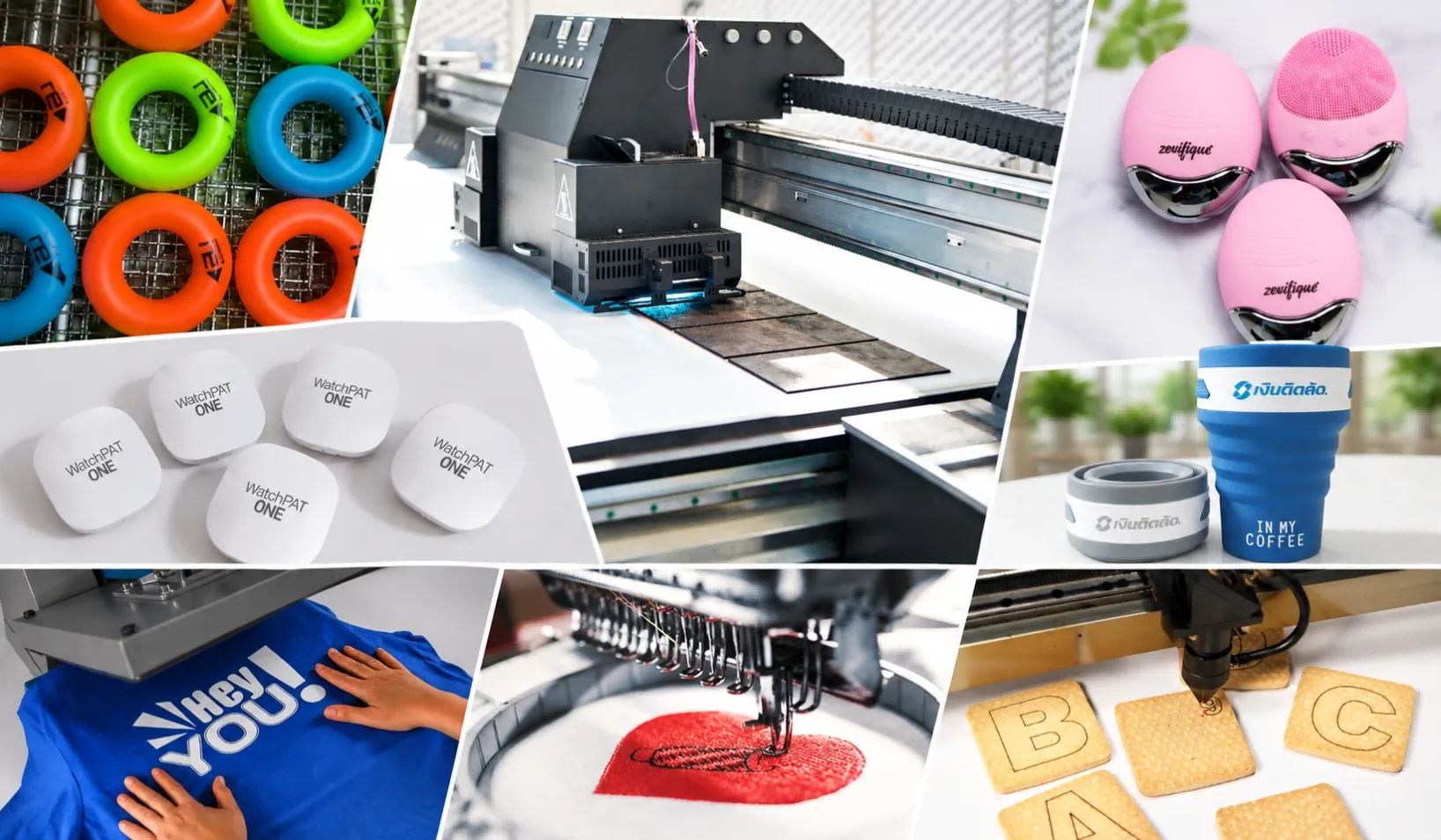
Your logo is going onto a product. The method that puts it there — screen printing, laser engraving, embroidery, UV printing or something else — determines how your brand looks in a customer's hand, how long it lasts, how much the order costs, and how much setup work your project needs before production even starts.
This guide is written for buyers sourcing branded products from China. It explains the main logo application methods, what each one is genuinely good at, where each one fails, and how to choose between them for a specific product, artwork and order quantity.
Printing vs Engraving vs Embroidery: The Three Families
Logo application methods fall into three families, and knowing which family a method belongs to explains most of its behavior:
Family | How It Works | Methods | Character |
|---|---|---|---|
Printing | Ink or film transferred onto the surface | Screen printing, pad printing, UV/ digital printing, heat transfer | Full color possible; most flexible on color; durability varies |
Engraving / marking | Surface material removed or altered | Laser engraving, laser marking | Permanent; single-tone result; premium feel |
Stitching / textile | Thread stitched into the material | Embroidery, woven labels | Textile-specific; durable; limited detail |
The practical consequence: if you want a multicolor logo, you are choosing within the printing family. If you want a permanent mark with a premium, understated look, you are choosing engraving. If the product is fabric, embroidery is usually in play. Most buyer errors come from wanting a multicolor result on a method that cannot deliver it, or choosing engraving for fine detail it cannot render.
The Main Methods, What They Do Well, and Where They Fail
Screen Printing
The workhorse method for flat surfaces: tote bags, notebooks, folders, some packaging, apparel. Ink is pushed through a mesh screen; one screen is made per color.
- Good at: solid colors, large flat areas, high durability on textiles, low cost per unit at volume.
- Fails at: fine gradients and photographic detail; each additional color adds a screen and cost; not suitable for curved or heavily textured surfaces.
- Watch for: on dark products, each color needs an underlay print (a white base) so the color reads correctly — this is normal and should be quoted.
Pad Printing
The standard method for small, curved or irregular items: pens, small gadgets, hardware with curved caps. Ink is transferred from an etched plate via a silicone pad.
- Good at: small items, curved surfaces, single or two-color logos, low setup cost compared with screen printing.
- Fails at: large print areas, fine detail at small sizes, gradients.
- Watch for: print size is limited by the pad; artwork must be simplified for very small areas.
UV Printing / Digital Printing
A modern method that prints directly onto surfaces — including curved, textured or non-flat products — with full-color capability and no per-color setup.
- Good at: full-color and gradient logos, one-off or low-quantity runs, complex shapes, photography-style artwork.
- Fails at: very high volume cost control (per-unit cost is higher than screen printing at large volumes); durability on items subject to heavy abrasion depends on the surface and coating.
- Watch for: adhesion varies by material — always approve a physical sample to confirm the ink bonds properly to your specific product surface.
Heat Transfer Printing
Artwork is printed onto transfer film, then applied with heat and pressure. Common on drinkware, some bags and items where UV printing or screen printing is impractical.
- Good at: full-color art, complex shapes, small-to-medium quantities.
- Fails at: very high volumes (film cost), items exposed to heat or harsh washing.
- Watch for: wash durability on textiles — heat transfer degrades faster than screen printing or embroidery under frequent washing.
Laser Engraving
A laser removes or alters the surface material to create a mark. The result takes the color of the engraved material — a black mark on stainless steel, a lighter tone on wood, a darkened tone on leather.
- Good at: permanence (it cannot peel or fade), premium and understated appearance, fine line detail, no ink or consumable cost per impression.
- Fails at: multicolor output — an engraved logo is a single tone; glass and some coated surfaces may engrave inconsistently.
- Watch for: on coated or color-sprayed products, engraving cuts through the coating to the material underneath, which changes the visual result. Confirm on a sample.
Embroidery
Thread stitched into the fabric: caps, polos, bags with fabric panels, towels. Durable and tactile.
- Good at: durability, premium textile feel, small logos with strong shapes.
- Fails at: fine detail, small text, gradients — thread has a physical minimum width; intricate logos must be simplified into a stitchable version.
- Watch for: a one-time digitizing fee converts your logo into a stitch file; small text below roughly 4–5mm in height may not be legible.
Choosing the Right Method for Your Product and Artwork
Method selection follows from three inputs: the product surface, the artwork complexity, and the order quantity. Using them in that order avoids most mistakes.
If your product is… | And your logo is… | Recommended method |
|---|---|---|
Stainless steel tumbler / bottle | Single color or line art | Laser engraving (permanent, premium) |
Stainless steel tumbler / bottle | Full color or gradient | UV printing or heat transfer |
Tote bag | 1–3 solid colors | Screen printing |
Tote bag | Full color with fine detail | Heat transfer (check wash durability) |
Pen / small gadget | Simple logo | Pad printing |
Notebook (cover) | Elegant single tone | Foil stamping (screen or pad printing for flat color) |
Cap / polo / apparel | Simple shapes, small text | Embroidery |
Power bank / charger | Small logo on a curved shell | Pad printing or UV printing (avoid print zones near ports) |
Gift box / packaging | Full color | Offset or digital printing (packaging factory) |
When in doubt, ask the supplier which method they recommend for the specific product — a factory that makes a product daily knows exactly which method works on its surface and which one produces complaints. Their answer often includes a surface caveat (coating, texture, material) that no generic guide can tell you.
What Each Method Does to Setup Cost and Unit Price
The cost structure differs in a way that matters for budgeting: printing methods front-load setup (screens, plates, films), engraving and embroidery front-load less but vary more per unit, and generally all methods reduce unit cost as quantity rises.
- Screen printing: setup per color (screen) + low per-unit cost. Best cost profile at high volume with few colors.
- Pad printing: lower setup than screen printing (plate) + low per-unit cost. Best for small items at any reasonable volume.
- UV / digital printing: minimal or no setup per color + higher per-unit cost. Best for low volumes, multi-color art, and one-piece personalization.
- Heat transfer: moderate setup (film) + moderate per unit. Middle ground when the surface rules out other methods.
- Laser engraving: low setup (fixture + file prep) + low per unit that does not change with logo complexity. Best cost profile for single-tone logos at volume.
- Embroidery: one-time digitizing + per-unit thread and machine time that scales with stitch count (logo complexity).
Two budgeting rules follow. First, if your logo has multiple colors, the printing method's per-color setup makes a single-tone alternative (engraving) cheaper at every volume — decide whether the color is worth the setup. Second, for very low quantities, digital methods with no per-color setup are usually the most economical, because they avoid paying setup costs that a small run cannot absorb.
How Artwork Must Be Prepared for Each Method
Good artwork preparation prevents most production problems. The universal requirement: supply vector artwork (AI, EPS or PDF) or a high-resolution file suitable for tracing. A low-resolution JPG will not produce a clean print or a clean engraving.
Method-specific notes:
- Screen and pad printing: artwork must be split into individual colors; each color becomes a separate screen or plate. Gradients must be converted to banded colors or moved to a different method.
- UV and digital printing: full-color artwork is used directly; supply the file at the resolution and color space the factory requests (usually CMYK, sometimes with a Pantone reference for critical colors).
- Laser engraving: the artwork becomes a single-tone mark; fine lines and small text must be evaluated at the final size — a 1mm line or 3mm text may vanish in engraving. Convert your logo to a single-color black version to preview what will be engraved.
- Embroidery: the logo must be simplified into stitchable shapes; small text and fine lines will need thickening or removal, and this simplification should be approved by you before production — it changes the look of the logo.
A practical habit: always ask the supplier to send the production file (digital proof or stitch file preview) for approval before production, and approve the physical sample — not just the file — before the full run. The gap between screen and physical result is where most logo complaints originate.
Quality Checks Buyers Should Perform on a Logo
When the sample arrives, check the logo the way your customer will see it:
- At realistic distance. Hold the product at arm's length. Detail that looks crisp up close may be illegible where customers actually read it.
- Against the brand reference. Compare the logo tone with your brand colors under natural light. Agree on an acceptable tolerance in writing at sample approval.
- Placement and size. Check the logo position against the approved placement; a 3mm shift on a small item is visible.
- Durability where it matters. For printed logos on items that get washed or heavily handled, ask what the expected durability is and test a sample if the use case is demanding.
- Across the whole order. If the logo appears on multiple products, compare them side by side — color rendering differs between methods, and a black logo on matte steel next to a black logo on glossy packaging reads differently even when both are technically correct.
Frequently Asked Questions
What is the most durable way to put a logo on a product?
Laser engraving is the most durable because there is no ink or film to wear off — the mark is in the material itself. Screen printing and embroidery follow for textiles (embroidery is typically more durable under heavy washing). Heat transfer and some UV prints are the least resistant to abrasion and washing.
Can I print full-color logos on promotional products?
Yes — use UV printing or heat transfer, which reproduce full-color and gradient artwork. Screen and pad printing are limited to discrete colors (each color needs its own screen or plate), and laser engraving is single-tone by nature.
What is the minimum logo size for each method?
Pad printing handles the smallest sizes (small items like pens print logos only a few millimeters tall, simplified for legibility). Laser engraving can render fine line detail but small text below roughly 4mm may be unclear. Embroidery requires the largest minimum because thread has physical width — text under roughly 5mm is generally not stitched cleanly. Always confirm with the factory for your specific artwork.
Does adding colors to a logo increase cost?
For screen and pad printing, yes: each additional color adds a one-time setup (another screen or plate) and a small per-unit cost. For UV and digital printing, additional colors do not add setup cost. For laser engraving, logo complexity does not change the cost. If your logo has several colors and the budget is tight, a single-tone version in engraving is usually the most economical premium option.
Can the same logo be applied to different products in one order?
Yes, but expect the same artwork to be applied by different methods on different products — engraving on a tumbler, screen printing on a bag, embroidery on a cap. Approve each application on its physical sample, and compare the applications side by side before production starts. Our guide to sourcing multiple corporate gift products covers how to coordinate this.
Next Step
Logo application comes down to three questions: what surface is the logo going on, how complex is the artwork, and what quantity are you ordering. Match those to the method families above, ask the factory to confirm surface-specific behavior, and approve a physical sample before production.
If you have a logo file and a product in mind, we can recommend the method, flag the artwork adjustments each option requires, and quote the setup and unit costs for comparison. Browse our product categories to see typical applications, or send us your logo and product requirement for a method recommendation and quote.