
Oct 14, 2026Sourcing Guides
How to Source Corporate Gifts for Multiple Office Locations
How to ship corporate gifts to multiple office locations from China — three delivery models compared, per-destination landed cost, and one gift standard across offices.

Shipping corporate gifts to multiple office locations is a coordination problem, not a product problem. The gift itself — a branded tumbler, a welcome kit, a holiday set — is the easy part. Getting identical gifts to five, ten or thirty addresses across different countries, on the same occasion, with one consistent brand standard, is where programs succeed or fail.
The short answer: the cleanest model for most companies is direct shipping from the supplier to each destination — one production batch for consistency, separate freight bookings per destination, customs handled per market. Send every destination address to the supplier, request freight and duty estimates per destination, and plan each delivery backward from its own handover date. If your destinations are few and domestic, hub consolidation can be cheaper; if they cluster in one region, regional consolidation beats both.
This guide explains how to choose between the three delivery models, what changes about packaging and landed cost when you ship to many addresses, how to keep one consistent gift standard across markets, and the questions your finance team will ask before approving cross-border gift shipments.
What Are the Three Delivery Models for Multi-Location Gifting?
Every multi-location program uses one of three logistics models — or a combination. The choice drives cost, lead time and how much internal work your team does after the gifts leave the factory.
Model 1: Direct Shipping to Each Destination
The supplier produces one batch, packs per destination, and ships each batch directly to its office — from the factory in China, or from the supplier's local warehouse if they hold stock. Each destination clears its own customs, or your supplier ships DDP (delivered duty paid) so duties are settled before arrival.
Best for: programs with destinations in different countries, tight per-destination deadlines, or a small internal operations team. Freight cost is higher than consolidating, but nobody on your side touches a box.
Model 2: Hub Consolidation and Forwarding
Everything ships to one hub — usually headquarters or a central warehouse — and your team (or a local logistics provider) receives, checks, repacks and forwards each destination's share. The gifts travel as one shipment from the factory, then as several smaller shipments from the hub.
Best for: companies that want to inspect everything in one place before distribution, or that bundle gifts with other materials (welcome paperwork, IT equipment) before shipping to each office. Accept that your freight is paid twice and that repacking is internal labor.
Model 3: Regional Consolidation
Gifts ship in two or three regional batches — one for Europe, one for North America, one for Asia-Pacific — to a regional hub each, then distribute locally. This splits the difference: fewer international legs than direct shipping, less internal handling than full hub consolidation.
Best for: programs with several offices per region, or a mix of countries where customs is easier in one hub country than others.
Factor | Direct to Each Destination | Hub & Forward | Regional Consolidation |
|---|---|---|---|
Freight cost | Highest (many small shipments) | Lowest international leg, plus second-leg cost | Middle (few consolidated legs) |
Internal work | None | High (receive, sort, repack, forward) | Low to medium |
Customs complexity | One clearance per destination | One import at hub; possible re-export issues | One clearance per region |
Per-destination deadline control | Direct control per leg | Depends on internal turnaround | Per-region control |
Best fit | Multi-country, tight dates, small team | Inspection or bundling needs | Multiple offices per region |
A practical rule: if your internal team's time has a cost — and it does — the model that looks cheapest on freight quotes often is not the cheapest overall. Count the repacking hours when comparing hub consolidation to direct shipping.

One production batch for the whole program — then per-destination freight planning begins.
Case Example: One Order, Three African Countries
The model in practice. A university in Africa needed promotional gifts — pens, water bottle bags, buckets and PVC folders, 12,500 pieces in total — delivered to three of its campuses located in three different countries. We produced the whole order as one batch in China, then split, packed and shipped it as three separate consignments.
The workflow, in the order it happened:
- One production run for all three destinations. The full quantity was manufactured together, so every campus received identical products with identical branding — the consistency anchor working exactly as described above.
- Split by destination quantity after production. When all the goods were ready, the order was broken down by each university's requirement: the pens, bags, buckets and folders were counted out and packed into the quantities each campus needed (4,500 pieces to one country, 3,000 to the second, 5,000 to the third).
- Per-country packing lists and carton marks. Each destination's cartons were labelled with their own shipping marks, and a separate packing list was prepared per country — with HS codes, quantities, carton dimensions and total weights — so each consignment could clear customs independently. The image below shows what those packing schedules look like in practice:
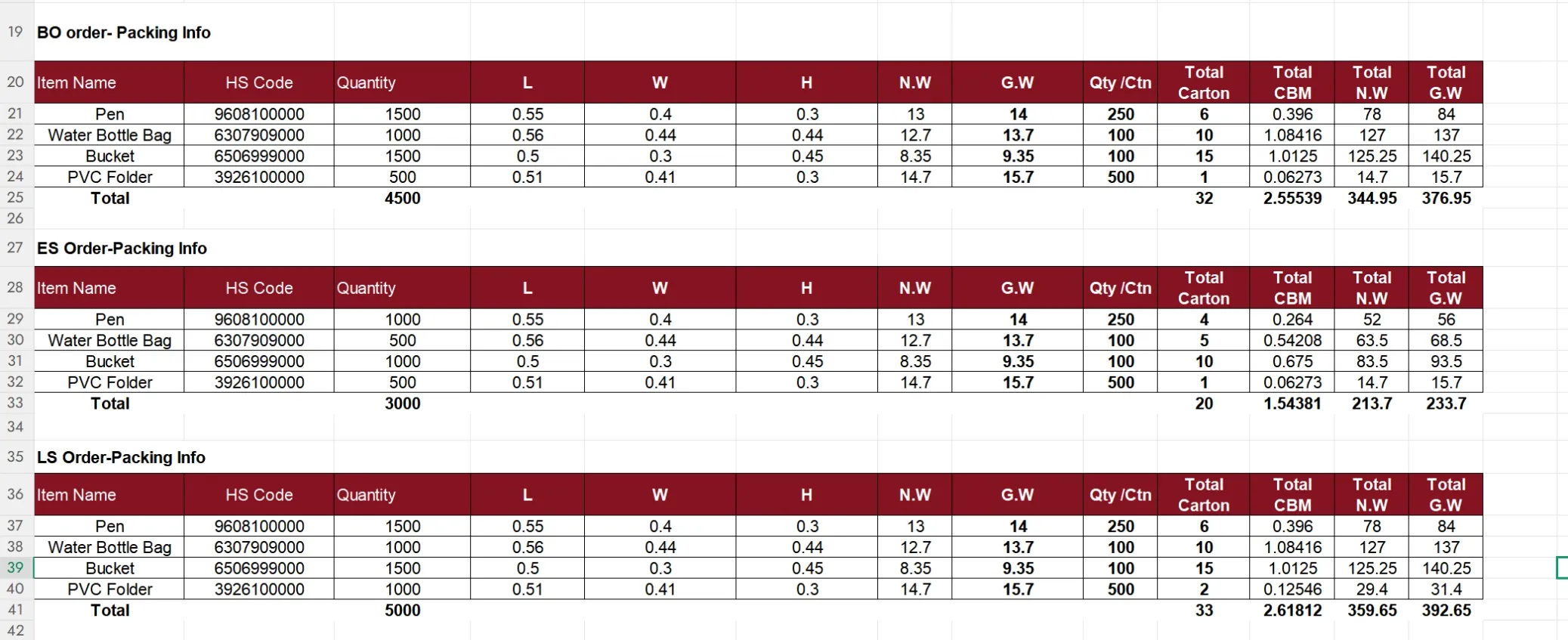
Three separate packing lists for one order — BO, ES and LS each with their own item quantities, HS codes, carton counts and weights (32, 20 and 33 cartons respectively). This is what "one order, three destinations" looks like at the documentation level.
- Sea freight from Shenzhen, per destination. The three consignments shipped by sea from Shenzhen to their respective destination countries, each with its own documentation and receiving arrangements.
Three lessons this case proves out, which apply to any multi-location program:
- The split is a packing exercise, not a production exercise. Producing one batch and dividing it afterwards costs far less than running three separate production orders — and it is the only reliable way to keep product and branding identical across campuses.
- Per-destination documentation is the real work. Three customs clearances mean three sets of HS codes, packing lists and carton marks. Preparing them at the packing stage (not at the port) is what keeps consignments moving.
- Sea freight rewards the plan; it punishes the rush. Shipping by sea to three African destinations made the per-unit freight work — but it required the split and packing to be finished before the container was sealed. The margin for error is in the packing stage, not the shipping stage.
Why Does Multi-Location Gifting Create Problems a Single Order Never Has?
A single-location order is straightforward: approve the sample, place the order, receive the goods. A multi-location order runs every step once per destination — and then synchronizes the results. That multiplication creates four specific failure points:
- MOQ conflicts. A notebook supplier's minimum might be 1,000 pieces while one office needs 300. You either buy up, reallocate quantities across offices, or find a supplier whose minimum fits the total. One supplier for the whole program usually beats one supplier per office, because combined volumes move you above minimums.
- Timeline misalignment. Air freight to New York and sea freight to Rotterdam run on different clocks. Align the delivery windows, not the shipment dates — then work backward from each destination's event or handover date.
- Sample multiplication. One product may serve every office, so one sample and one approval can cover the program. The mistake is letting each regional office run its own product approval — that is how consistency dies at the sample stage.
- Consolidation decisions. Somewhere, someone decides whether gifts ship individually boxed or as bulk plus flat-packed boxes. That decision changes packing cost, freight volume and assembly labor. Make it once, in writing, before production.
How Should You Package Gifts for Multiple Destinations?
Packaging decisions that are invisible in a single-location order become the biggest cost and risk factors in a multi-location program. Three questions drive every packaging choice.
Will the Gift Packaging Survive International Transit?
Retail-style gift boxes — the rigid magnetic-closure kind that looks premium in a showroom — are usually not made for container freight. They scuff, dent at corners and absorb moisture. If the presentation box must arrive pristine at every destination, ship each gift inside an export carton built for the route, and treat the gift box as an inner component. Ask the supplier for the drop-test standard they build to for each leg; if they cannot answer, that is a risk signal.
Individually Boxed or Bulk Per Destination?
Individually boxed arrives ready to hand out — no local packing labor, no missing components. Bulk plus flat-packed boxes costs less to ship but puts assembly work at each destination: someone must unbox, insert items, close and seal every gift. Common practice for multi-location programs:
- Executive and client gifts: individually boxed at the factory. Presentation matters, volume is low, assembly errors at the destination are not acceptable.
- Employee gifts at scale: bulk shipment plus flat-packed gift boxes, assembled locally, when the destination has a team to do it and per-unit freight savings justify the labor.
- Mixed programs: individually boxed for the tier that faces clients, bulk for the tier that stays internal.
How Do Freight and Landed Cost Change Per Destination?
Product cost is the same everywhere in the program; everything after the factory gate changes by destination. Landed cost — the number your finance team actually needs — is product plus customization plus packaging, plus freight, plus duties and taxes, plus local delivery. A sample per-destination landed cost model:
Cost Element | Same for All Destinations? | What Changes |
|---|---|---|
Product & customization | Yes (one specification) | Nothing — this is the consistency anchor |
Freight | No | Distance, mode (air vs sea), weight bracket, remote delivery surcharges |
Duties & import taxes | No | Country tariff treatment of promotional goods, VAT/GST rules, de minimis thresholds |
Customs brokerage | No | Per-destination clearance fees; higher where documentation issues recur |
Local delivery | No | City vs remote location; multi-address drops within one city add per-stop fees |
Ask for freight and duty estimates per destination in the quote — not one blended number. The highest-cost destination becomes the planning anchor for its region's budget, and usually reveals itself as the one with the tightest deadline or the most remote address.
How Do You Keep the Gift Consistent Across Every Location?
Consistency is the point of a multi-location program. Offices talk to each other; employees in London and Singapore will see each other's gifts. The working standard:
- One product specification for the whole program — same model, same materials, same quality grade.
- One packaging specification — same gift box, same insert, same presentation.
- One quality standard — same inspection checklist and pass/fail rules for every production batch.
Where budgets genuinely differ by region, adjust quantity or add a local recognition element — not the product tier or packaging standard. Changing the gift per market creates the exact comparison problem the program was designed to avoid. One exception worth allowing: local gift customs and taboos. If a specific market's norms rule out a product category (alcohol, leather, certain colors), that market is a documented exception approved before design freeze — not a regional improvisation after production.
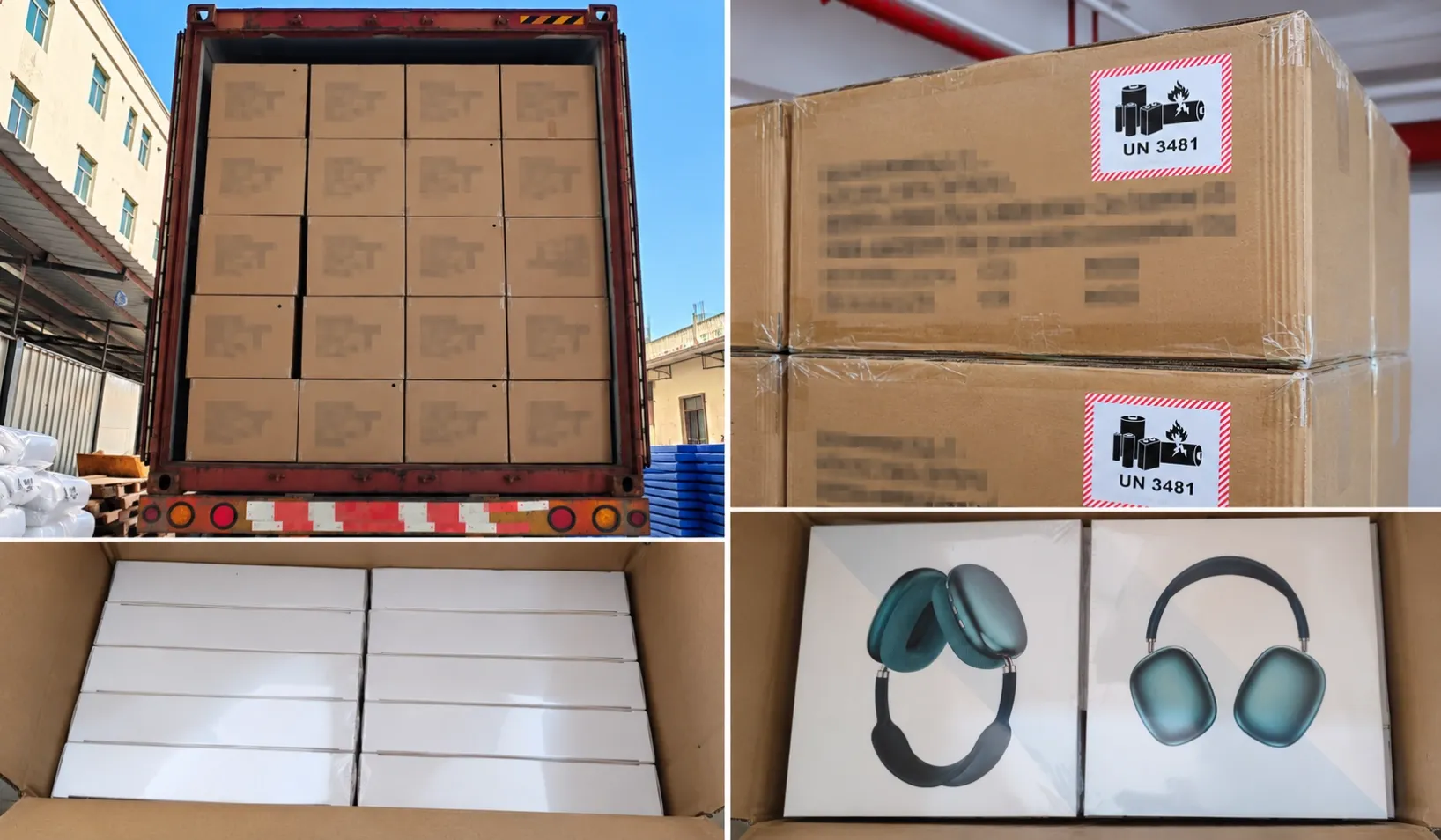
Packed and checked before dispatch — every destination's batch held to one quality standard.
What Will Your Finance Team Ask About Cross-Border Gift Shipments?
Before any multi-country gift program is approved, finance asks questions that go beyond the quote. Answering them early saves weeks.
Is the gift deductible, and up to what value? Many tax systems cap business gift deductions or exemptions per recipient. Commonly cited thresholds include the US federal deduction limit of $25 per recipient per year (with exceptions for items under $4 with branding, and incidental costs like shipping), the UK's £50-per-employee trivial benefit exemption, and Germany's €50 employee gift threshold. Rules vary by market, and some countries treat business gifts as fully non-deductible — treat any number as a starting question for your tax advisor, not a plan.
How are promotional goods classified at customs? Whether a shipment is declared as commercial samples, promotional materials or gifts affects duty rates and clearance speed in most markets. Ask your supplier to prep the commercial invoice and packing list per destination with a consistent, accurate description — inconsistent declarations across destinations are a classic customs trigger.
Who pays duties — and can the cost be known in advance? Under DDP terms the supplier (or their freight partner) handles duties and you see landed cost in the quote. Under DAP or EXW, your local entity pays on arrival — which is fine for countries where your company is registered, and a pain where it is not. For destinations without a local entity, DDP usually earns its premium.
Does the budget work per destination, not per unit? A program that looks cheap per unit can be expensive per delivered gift once freight and duties are counted for remote destinations. The per-destination landed cost table above is the format finance wants to see.
How Long Does a Multi-Location Gift Program Take?
For standard products with logo customization shipped directly to each destination: plan 6–10 weeks from project start to final delivery. The dominant variables are production (2–5 weeks) plus the longest single leg of transit and customs, plus a two-week buffer per destination.
Stage | Typical Duration | Multi-Location Adjustment |
|---|---|---|
Selection and quoting | 1–2 weeks | Add all destinations to the brief; request freight quotes per destination |
Sampling | 1–4 weeks | One sample for the whole program — resist regional re-approvals |
Production | 2–5 weeks | One batch for all destinations wherever possible |
Packing for transport | 3–7 days | Individual-boxed vs bulk decisions per destination add 1–2 days |
Shipping | 1–8 weeks per leg | Each destination runs its own transit clock; modes differ by distance |
Customs clearance | 2–7 days per destination | Budget per destination; documentation errors add days |
Two planning rules that prevent most late deliveries: align delivery windows (not shipment dates) by working backward from each destination's event date; and build the buffer per destination, not once for the program. Seasonality — Chinese New Year production shutdowns, Q4 freight congestion — makes buffers non-negotiable; our guide to corporate gift lead times covers the calendar in detail.
What Should the Quote Request Include for a Multi-Location Program?
Send one brief covering all destinations, structured so the supplier can quote the full program:
- Destination list — each address with country and quantity per destination.
- One product specification for all destinations — states the consistency requirement from day one.
- Packaging requirement — individually boxed or bulk plus flat; where assembly happens per destination.
- Freight per destination — ask for each destination's freight separately, air and sea where the timeline allows.
- Delivery windows — the event or handover date per destination, not one blended deadline.
- Duties expectation — who clears customs (your side, or DDP terms), and the estimated landed cost per destination.
Ask for the quote structured by destination: product cost shared across the program, freight and duties itemized per destination. This format makes budget approval straightforward and immediately shows which market is expensive — usually the tight-deadline or remote one. If you have not yet decided on products, browse our product categories first, then send the brief.
Frequently Asked Questions
What is the best way to deliver corporate gifts to multiple offices overseas?
For most multi-country programs, direct shipping from the supplier to each destination is the cleanest model: one production batch for consistency, separate freight bookings per destination, customs handled professionally per market. It costs more in freight than consolidating to one hub — but the alternative pays freight twice and turns your internal team into repackers. If several offices sit in one region, regional consolidation is the middle path.
How do I budget for gifts shipped to different countries?
Budget by landed cost per destination, not per unit. Product, customization and packaging costs are identical across destinations; freight, duties and local delivery are not. Ask for freight and duty estimates per destination, plan each region against its own number, and treat the most expensive destination as the planning anchor for its region.
Should all offices receive identical gifts?
Yes — with documented exceptions for local gift customs or legal restrictions, the standard is one product, one packaging specification, one quality standard. Where budgets differ, adjust quantity per office or add a local recognition element; changing the product or packaging tier per market creates exactly the comparison problem the program exists to prevent.
How long does a multi-location gift program take?
Plan 6–10 weeks from project start to the last delivery for standard products with logo customization, longer with sea freight or destinations on different continents. The controlling variables are production time plus the longest transit-and-customs leg, plus a two-week buffer per destination beyond the calculated schedule.
How do I handle customs for gifts shipped to several countries?
Use DDP terms where the supplier offers them — duties are settled and landed cost is known before production. On DAP or EXW terms, your local entity handles clearance and duty payment, which works where you have a registered entity and gets complicated where you do not. Whatever the terms, get duties estimated per destination in writing and ensure the commercial invoice describes the goods consistently across all destinations.
Can we expense corporate gifts across multiple countries?
Usually yes, but deductibility and reporting rules differ per market — commonly cited limits include $25 per recipient in the US, £50 per employee in the UK, and €50 for employee gifts in Germany, and some markets disallow business gift deductions entirely. Get your finance team to confirm treatment per destination before the budget is approved, and keep per-destination invoices that match the shipment records.
Next Step
Multi-location gift programs come down to four decisions: pick the shipping model (direct per destination, hub-and-forward, or regional consolidation), specify packaging that survives international transit, hold one product and presentation standard across every office, and plan backward from each destination's date with a per-destination buffer.
If you are planning gifts across several offices, send us your destination list, quantities and delivery windows — we will quote freight per destination, confirm one consistent product and packaging specification for the program, and coordinate production and shipping so every office receives its gifts on time.