
Oct 20, 2026Buying Guides
Custom Power Banks: The Complete Purchasing Guide for B2B Buyers
A B2B purchasing guide to custom power banks: capacity and watt-hour limits, format selection, PD and QC fast-charging standards, certification for air freight, branding methods, cost structure, and h
Custom Power Banks: The Complete Purchasing Guide for B2B Buyers
A branded power bank is one of the few promotional products that survives past the first week. It solves a problem every recipient has, it is used in public, and it carries the logo into places a notebook or a tote bag never reaches. That is why it holds its place in corporate gift and event programs year after year — and why the category is also one of the easiest places to waste money.
The failure mode is almost never the logo. It is the specification: a unit with the wrong capacity for the use case, a cell that fails within months, a certification the destination customs office rejects, or a cable the recipient loses before the second charge. This guide covers the decisions a buyer actually has to make — capacity, format, fast-charging standards, branding method, certification and freight — and where the cost traps sit in each one.
Why Power Banks Work in Corporate Programs
A custom power bank works in a corporate program for a simple reason: it is the rare promotional item that solves a problem the recipient has every day. The same logic applies whether you are buying a personalized power bank for a client tier or a bulk order of branded units for a conference — the item has to be good enough to keep using.
- High perceived value at a workable unit cost. A power bank reads as a real product rather than a trinket, which is exactly what a corporate gift needs to do.
- Used daily, branded daily. Phones run out; the charger comes out. The logo is seen in the places a desk item never reaches — on trains, in airports, at conferences.
- Universally applicable. Employees, clients, conference attendees and sales prospects all have the same problem, so one specification can serve an entire program.
- Airline-relevant. Since power banks must travel in cabin baggage, a compliant unit stays with the recipient rather than being confiscated at security.
- Reorder-friendly. Standard models keep their tooling and specifications, so a program can restock without a new sampling round.
Capacity: How Much Do You Actually Need?
Capacity is quoted in mAh, but the number that matters for travel and compliance is watt-hours. The conversion depends on the cell's nominal voltage, and for the lithium cells used in these products a 10,000mAh pack works out to roughly 37Wh.
Capacity | Approx. Wh | Real-World Use | Best For |
|---|---|---|---|
5,000 mAh | ~18.5Wh | One full phone charge | Event giveaways, budget tiers |
10,000 mAh | ~37Wh | Two to three phone charges | The corporate gift standard — best balance of value, weight and shipping |
20,000 mAh | ~74Wh | Four to five phone charges, plus a tablet | Client and VIP gifts, travel programs |
27,000 mAh+ | ~100Wh | Laptop charging | Niche; sits at the airline cabin limit |
Two practical rules follow. First, 10,000mAh is the right default for most corporate programs: it is genuinely useful, still pocketable, and keeps freight and documentation simple. Second, capacity is capped by airline rules, not by manufacturing — most carriers limit cabin baggage to 100Wh (27,000mAh) and many require approval above that, so a larger pack can become a gift the recipient cannot legally fly with.
Capacity also determines whether the unit works as a custom power bank charger for a whole day away from a socket, or only as a top-up. For conference programs and travel-heavy recipient groups, the difference between one charge and three is the difference between an item that gets used and one that gets replaced.
Formats and Which One Fits Your Program
Format | Description | Strength | Watch Out For |
|---|---|---|---|
Slim pocket power bank | Flat, credit-card sized, 5,000–10,000mAh | Lightest and cheapest to ship | Small capacity; no cable included unless specified |
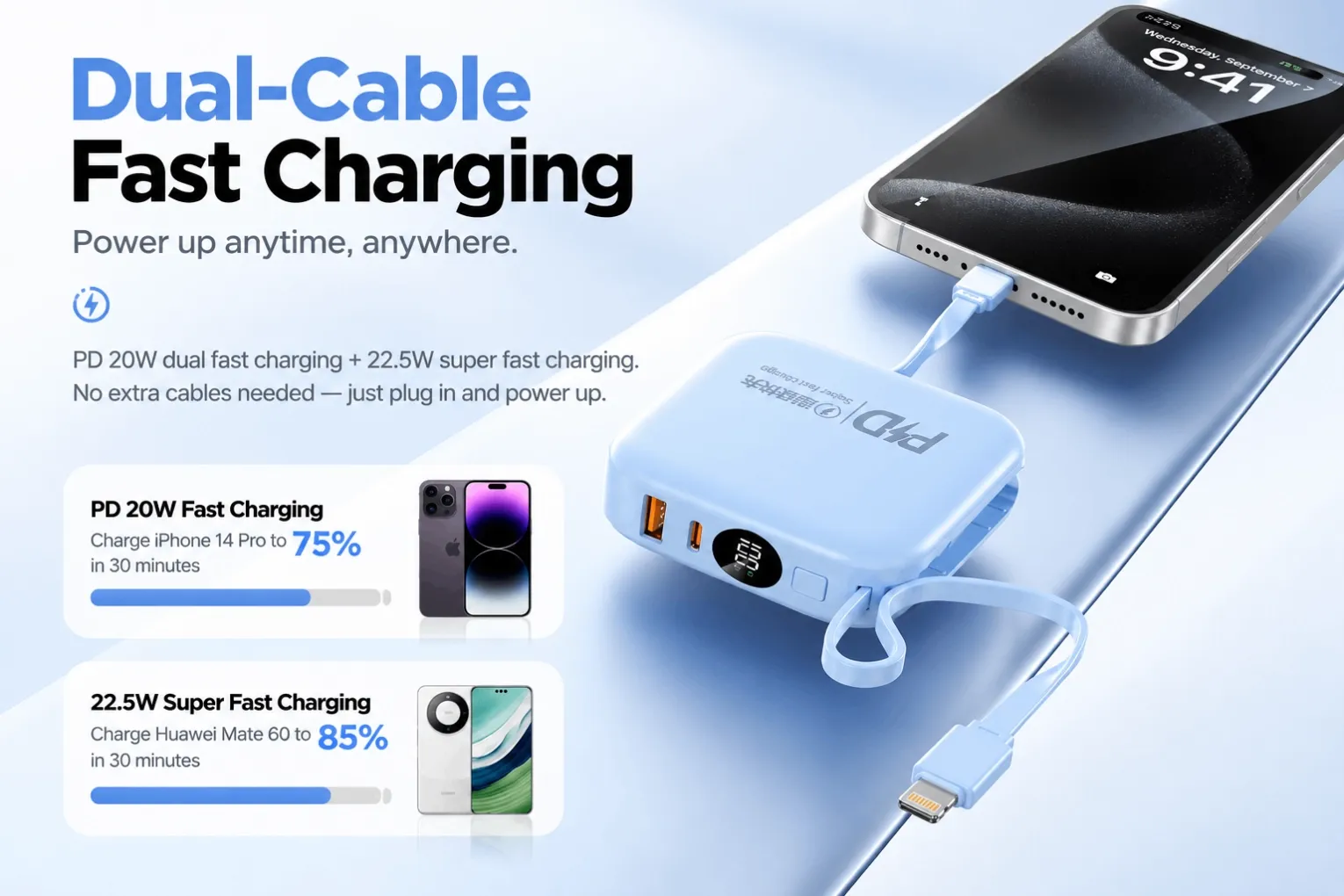
Power bank with built-in cables | Cables integrated into the housing | Nothing for the recipient to lose — the single biggest driver of continued use | Slightly bulkier; cable wear is the failure point |
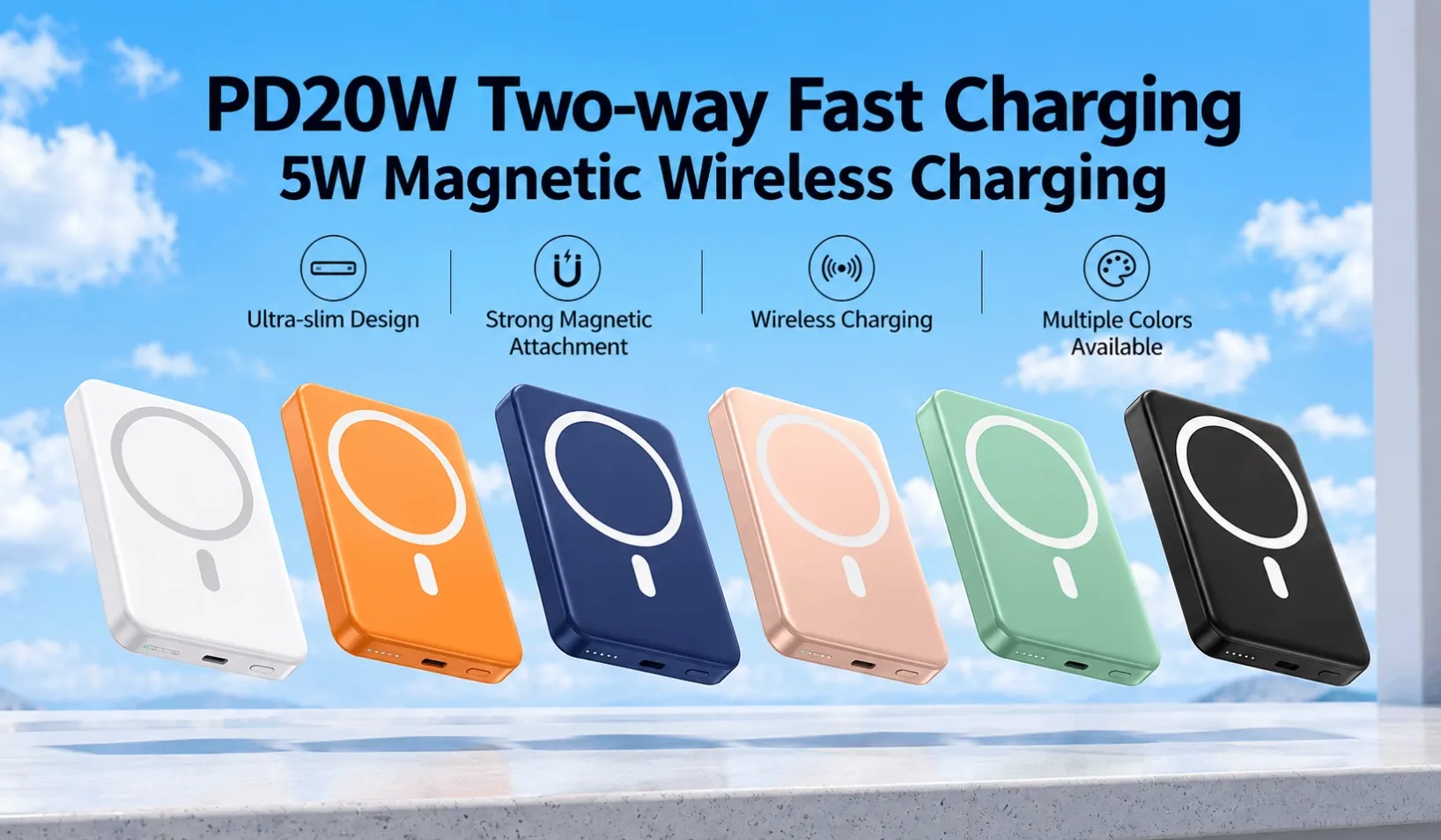
Magnetic wireless power bank | Snaps to the back of a phone, charges without a cable | Premium feel; strong for client gifts | Requires a magnetic-compatible phone; higher unit cost |
High-capacity travel pack | 20,000mAh and above | Highest perceived value | Heaviest; freight cost rises sharply |
Power bank gift set | Boxed with a cable, stand or pouch | Presentation value; suits onboarding and VIP tiers | Assembly and box add cost and volume |
One further format distinction worth knowing: promotional portable chargers are usually bought by the case for distribution at events, while a power bank gift set is bought by the box for individual presentation. The first is priced on unit cost and freight, the second on presentation value — and they are usually specified with different capacities for that reason.
For most corporate programs the built-in-cable format is the highest-performing choice, and the reason is behavioural rather than technical: people lose cables. A power bank whose cable is part of the body still works on month six; one that needs a separate cable often does not.
The same logic explains why custom portable chargers have taken share from plain battery packs in promotional programs: buyers are no longer specifying a charger as an add-on, but as the item itself, and they expect it to work without accessories. When your programme needs a specific form factor — a slim unit that fits a conference lanyard pouch, or a magnetic model for a premium client tier — that specification is worth stating explicitly rather than leaving to the supplier's stock range.
Fast Charging: PD, QC and What the Numbers Mean
Fast-charging standards are where specifications get confusing, and where suppliers overstate. The three that matter:
- PD (Power Delivery) — the USB-C standard used across modern phones, tablets and laptops. A PD 20W unit charges a current iPhone or Android phone quickly and can usually charge the pack itself at the same rate. Bidirectional PD means the same port both accepts and delivers power at that rate.
- QC (Quick Charge) — Qualcomm's standard, common on Android devices. A unit supporting QC 3.0 or above will fast-charge compatible phones over USB-A.
- Proprietary standards — several Chinese phone brands use their own higher-wattage protocols (22.5W and above). These deliver the fastest charge only on that brand's devices, so a "22.5W super fast charge" claim usually means the unit supports that protocol in addition to PD and QC.
The trap is comparing headline wattage across units that use different standards. A 22.5W unit that only fast-charges one phone brand is not better than a 20W unit that fast-charges everything. Ask which standards the unit supports and at what wattage on each, and test both an iPhone and an Android device on the sample.
Certification: The Part That Decides Whether It Ships
Power banks are regulated as dangerous goods for transport, and the documentation requirements are not optional. Buyers who treat certification as paperwork discover the problem at the port.
Certification is the part most promotional buyers underestimate, because a power bank is a regulated battery product rather than a general giveaway. If this is your first battery order, our quality control guide covers the inspection process that runs alongside it.
Document | What It Covers | When You Need It |
|---|---|---|
UN38.3 | Cell and pack safety testing for transport | Always — mandatory for air freight |
MSDS | Material safety data sheet | Always, for shipping documents |
CE / RoHS | EU conformity and hazardous-substance compliance | EU destinations |
FCC | US electromagnetic compliance | US destinations |
3C | China Compulsory Certification | Manufacture and export from China |
IEC 62133 | Cell-level safety standard | Requested by some EU and retail buyers |
Two things to verify rather than assume. First, that the UN38.3 report matches the specific model and cell you are buying — reports are model-specific, and a supplier who offers "our UN38.3" for a different product is not providing what customs expects. Second, that the destination market's labelling requirements are met: battery products carry specific marking rules in the EU and US that differ from general promotional goods.
Branding Power Banks: Methods and Their Limits
Method | Result | Best For | Durability |
|---|---|---|---|
UV full-colour printing | Detailed multicolour artwork in one pass | Complex logos, photographic designs | Good under normal use |
Pad printing | Clean single or two-colour mark | Simple logos at volume | Good |
Laser engraving | Permanent mark cut into the surface | Aluminium-shell models | Excellent — cannot wear off |
Custom housing colour | Body moulded or painted in your brand colour | Programs needing exact brand match | Permanent, but higher MOQ |
Placement matters as much as method. The front face is the visible side in use and the default position; the back is where a laser engraving usually sits. If the design includes a digital display, confirm the logo does not crowd it — a common problem on compact units where the display takes the centre of the face. For a power bank with logo artwork that needs to read clearly at arm's length, a single clear mark beats a detailed design competing with the display. Programs that specify power banks with logo printing across several rounding runs should lock the artwork template once and reuse it, so every reorder matches the first.
Buyers sourcing a customized power bank for a client tier usually want the mark to look deliberate rather than stamped: a small engraved logo on a matte body reads as premium, while a large printed logo on a gloss housing reads as promotional. Decide which impression the program is buying before choosing the method.
Cost Structure and Where the Money Goes
Unit price is set by five variables, in roughly this order of impact:
- Capacity — the cell is the largest single component cost. Moving from 5,000 to 10,000mAh is the biggest price step in the range.
- Form factor and materials — an aluminium or magnetic-wireless unit costs materially more than a slim ABS model.
- Branding method — pad printing is cheapest; UV full colour and custom housing colours add cost and lead time.
- Packaging — a printed gift box can add meaningful cost per unit and significantly more to freight volume.
- Volume tier — the same specification at 500 versus 5,000 pieces differs substantially, and the step between tiers is larger here than in most promotional categories because of cell purchasing.
The cost trap specific to this category is cheap cells. A lower-grade cell lowers the unit price and passes any initial inspection, then loses capacity over a few months of use — the failure surfaces in the recipient's hands, which is the worst possible place for a branded gift to fail. Specify the cell type and capacity retention, and test a sample through several full charge cycles before committing.
It is also worth understanding why quoted prices move. When buyers compare custom branded power banks from different suppliers, the spread usually reflects the cell grade and the BMS rather than the housing or the printing. A quote that comes in well below the others is almost always cheaper in one of those two components, and both are invisible on arrival.
Packaging and Freight for Battery Products
Freight is where power bank programs diverge from ordinary promotional goods, and where lead times break.
- Air freight is possible but regulated: UN38.3 documentation is mandatory, there are limits on watt-hours per unit and on units per carton, and some carriers restrict battery shipments further. It is the fast option and the expensive one.
- Sea freight has fewer restrictions and is usually the better route for large programs with a longer lead time. Battery documentation is still required, but the cost per unit is far lower.
- Gift boxing multiplies freight cost because boxes are volumetric — a light but bulky gift box can cost more to ship than the product inside it.
- Event deadlines are the tightest constraint in this category. If the delivery date is a conference, plan the freight mode first and the production schedule around it, because a battery shipment that misses a flight has no cheap alternative that arrives in time.
Sourcing Power Banks from China
Four requirements separate a program that works from one that does not:
- One supplier holding the specification. Power banks combine a battery cell, a BMS (battery management system), a PCB assembly and a housing. A partner who holds your approved specification across those components can reorder without re-sampling and keeps quality consistent between runs.
- Certification verified per model. Confirm the UN38.3, CE and FCC documents match the exact model being produced, not a similar one from the same factory's catalogue.
- Samples tested as products. Charge an actual phone, run several full cycles, check the display accuracy and test the built-in cables under repeated flexing. A power bank that passes a visual inspection can still fail in the first month of use — see our pre-production sample guide for what to check before approving.
- Reorder terms agreed up front. Battery cell pricing moves with the market. Confirm how long the quoted price holds and what the reorder minimum is, so a program can restock six months later without a new negotiation.
This is also where custom power bank wholesale pricing differs from single-order retail buying: at wholesale volumes the cell procurement and the certification cost amortise across the order, so the per-unit gap between a 500-piece and a 5,000-piece run is larger than in most promotional categories. Programs that plan an annual volume and release it in one order consistently land in a better price tier than programs that reorder quarterly.
Lead times run longer than most promotional categories: sampling takes 7–12 days because of function and charging tests, production runs 20–30 days after approval, and freight is added on top. A program with a hard delivery date should start four months out.
Frequently Asked Questions
What capacity power bank should we choose for a corporate gift?
10,000mAh is the right default for most programs — around 37Wh, enough for two to three phone charges, still pocketable, and simple to ship and document. Choose 5,000mAh for high-volume event giveaways where unit cost and freight dominate, and 20,000mAh for client and VIP gifts where perceived value matters more than the unit price. Anything above 27,000mAh approaches the 100Wh airline cabin limit and creates a gift the recipient may not be able to fly with.
Can custom power banks be taken on a plane?
Yes, with two conditions: the unit must be within the airline's watt-hour limit (most carriers allow up to 100Wh in cabin baggage without approval), and it must travel in carry-on rather than checked luggage. At 10,000mAh a unit is around 37Wh, comfortably inside the limit. We supply UN38.3 test documentation with the shipment for airline or customs inspection.
What certifications do custom power banks need?
For export from China you need 3C certification, UN38.3 transport testing and an MSDS. For the destination market, CE and RoHS apply to the EU and FCC to the US, with IEC 62133 requested by some retail and tender buyers. The critical check is that the UN38.3 report matches the exact model and cell being produced — reports are model-specific, and a generic certificate will not satisfy customs or an airline.
How much does a custom power bank cost?
Unit cost is driven mainly by capacity, form factor, branding method, packaging and volume tier. The cell is the largest single cost, so the step from 5,000mAh to 10,000mAh matters more than any other specification change, and the difference between a 500-piece and a 5,000-piece order is substantial because cells are purchased at volume. Tell us the capacity, format, branding and quantity and we will quote against your actual requirement rather than a catalogue price.
Can we print our logo on a power bank?
Yes. UV full-colour printing handles detailed multicolour artwork, pad printing suits simple marks at volume, and laser engraving on aluminium-shell models gives a permanent mark that cannot wear off. Custom housing colours are available on volume orders for programs that need an exact brand match. Artwork position and size are confirmed at the sampling stage, with particular attention to the digital display area on compact models.
How long does production take for a custom power bank order?
Typical lead time is 20–30 days after sample approval, plus sampling at 7–12 days because of function and charging tests. Air freight is faster but regulated and expensive; sea freight is cheaper for large programs but adds several weeks. For a program tied to an event date, plan four months from specification to delivery and confirm the freight mode before locking the production schedule.
Should we choose a power bank with built-in cables?
For most corporate programs, yes. The single most common reason a gifted power bank stops being used is that the recipient lost the cable, and a unit with Type-C and Lightning cables integrated into the body removes that failure mode entirely. The trade-off is a slightly bulkier body and cable wear as the eventual failure point, so specify a cable that has been tested under repeated flexing.
Next Step
A power bank program comes down to five decisions: pick the capacity against the actual use case, choose a format — with built-in cables as the default — confirm the fast-charging standards rather than the headline wattage, verify certification per model, and plan freight before locking the production date.
If you are specifying a power bank program, send us the capacity, format, branding method, quantity and destination market. We will confirm the models that fit, quote at your volume, prepare the certification documents the shipment requires, and give you a sampling and production timeline you can plan around. You can also see the custom power banks product page for the flagship 10,000mAh model, or browse our product categories for other gift items in the same program.
More Models and Options
The specifications covered here represent the range most programs need, but our power bank range runs considerably wider — capacities from 5,000mAh to 20,000mAh, slim formats, magnetic wireless models, different cable combinations and premium metal-body versions. If you need a capacity, form factor or port configuration not described here, ask us for the complete power bank catalogue: we will send the full model list with capacity, output power, cable options and certification status so you can match the specification to your program.