
Oct 10, 2026Customization
Laser Engraving vs Screen Printing: Which Is Better for Corporate Gifts?
Laser engraving vs screen printing for corporate gifts — appearance, durability, color capability, cost structure and product suitability, with a method-by-product selection guide.
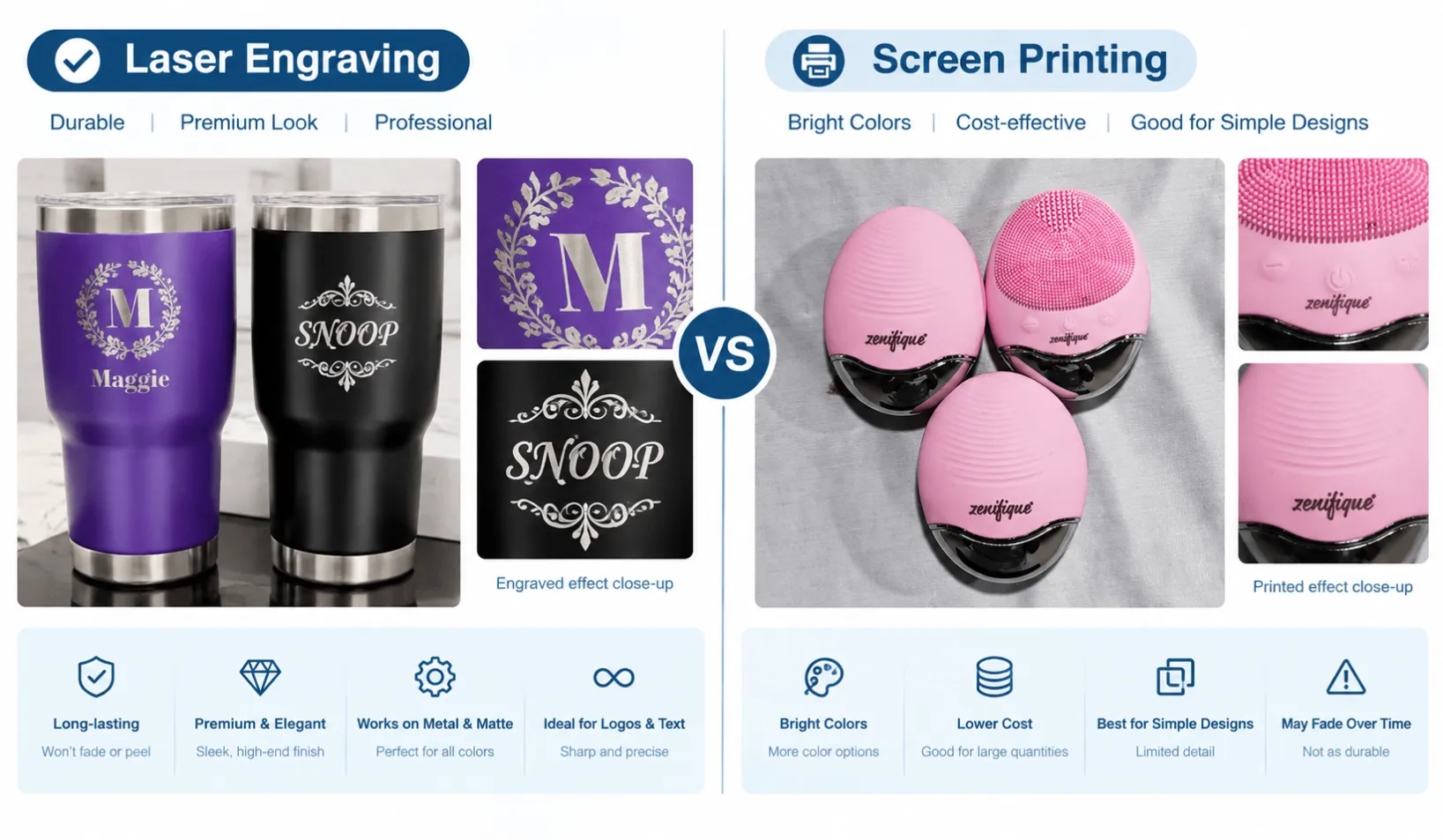
Laser engraving or screen printing — the question comes up on almost every branded product project, usually at the moment a buyer needs to approve artwork. The two methods look like alternatives, but they behave very differently: one burns a permanent mark into the material, the other lays ink on the surface. Choosing wrong means either a logo that will not last, or a logo you cannot reproduce in your brand colors.
This guide compares the two methods on the factors that actually decide the question: appearance, durability, color capability, cost structure, and suitability for specific products.
The Core Difference in One Paragraph
Laser engraving uses a focused laser to remove or alter the surface material, creating a mark in the material's own color — typically a matte black on stainless steel, a darker tone on wood, a burned-tone on leather. Nothing is added to the surface.
Screen printing pushes ink through a mesh screen onto the surface, creating a mark in the ink's color — which can be any color you specify, including white, brand colors or metallic inks. Something is added to the surface.
That single difference — removed vs added — determines everything else: how the logo ages, what colors are possible, how the cost behaves, and which products suit which method.
Appearance: How Each Look Reads on a Product
Factor | Laser Engraving | Screen Printing |
|---|---|---|
Color result | Single tone, from the material itself (usually darker or lighter than the surface) | Any specified color; exact Pantone matching possible |
Look and feel | Subtle, premium, integrated into the product — reads as "made for the brand" | Visible print with slight surface height; reads as "branded" |
Detail capability | High — fine lines and small text render cleanly within material limits | Good for solid shapes; fine lines and small text need review at final size |
Best surface | Metal, wood, leather, some hard plastics; coated surfaces can be engraved through | Flat, smooth surfaces: bags, notebooks, folders, some packaging |
Multicolor logos | Not possible — one tone only | Possible, with one screen and setup per color |
The look matters as much as the durability in corporate gift decisions: an engraved tumbler and a printed tumbler with the same logo communicate slightly different things. Engraving tends to read as premium and permanent — which is why it is the default choice for executive gifts and for metal drinkware. Printing reads as a practical branding method with full color control — which is why it dominates textile and paper products.
Durability: What Happens After Months of Use
This is the clearest difference between the two methods, and often the deciding factor for gifts that will be used daily:
- Laser engraving is permanent. There is no ink layer to fade, crack or peel, because the mark is in the material. A laser-engraved tumbler or pen keeps its logo through washing and daily abrasion, and the logo cannot be scratched off without damaging the product itself.
- Screen printing is durable but surface-dependent. On textiles, quality screen printing survives many wash cycles, though it can crack over years of heavy use. On drinkware and hard items, it can wear with aggressive scrubbing or dishwasher cycles. On items that see oils or abrasion (handled tools, frequently used drinkware), print edges can gradually soften.
Practical guidance: for products that will be used daily for years (drinkware, tools, pens), engraving removes the durability question entirely. For textiles and items where washing is infrequent or gentle, good screen printing is fully adequate for the life of a corporate gift.
Color: The Decisive Constraint
This is where most projects make the choice for you:
- If your logo must reproduce a specific brand color or multiple colors, engraving cannot do it. An engraved logo is a single tone based on the material. If your brand is defined by, say, a red-and-blue logo, an engraved black mark is a different visual identity — sometimes acceptable, sometimes not.
- If your logo is effectively monochrome — a wordmark, a symbol, a signature — engraving reproduces it faithfully on the right materials, with the bonus of a premium look.
- If you need white or a bright color on a dark product, screen printing offers a direct solution. Engraving on a black-coated product reveals the material underneath, which may be a lighter tone — a result some buyers love and others find surprising. Always confirm on a sample.
A useful test: convert your logo to solid black on a white background. If it still reads as your brand, engraving is a viable option. If the color is part of the identity, printing (or a hybrid approach — for example a small engraved mark plus a printed color element) is the direction.
Cost Structure: Where Each Method Wins
The two methods charge differently, and the difference becomes visible at different order quantities:
Cost Component | Laser Engraving | Screen Printing |
|---|---|---|
Setup | Low — file preparation and a fixture; no screen or plate per color | One screen per color; multi-color logos multiply setup |
Per unit | Machine time per piece; relatively flat regardless of logo complexity | Ink and pass time; low per unit at volume, but per color |
Effect of more colors | None — single tone anyway | Each color adds setup + per-unit cost |
Effect of quantity | Unit cost drops modestly; setup is already small | Unit cost drops sharply at volume as setup spreads |
Two practical patterns emerge. For single-color logos on metal products, engraving is usually comparable or cheaper than screen printing at all but the highest volumes, and it carries no color-matching risk. For multi-color logos at high volume, screen printing's setup-heavy structure spreads across thousands of units and the unit cost can become very low — but you are also paying for each color's screen.
Choosing Method by Product
Product | Better choice | Why |
|---|---|---|
Stainless steel tumbler or bottle | Laser engraving | Permanent, premium, works on curved metal; printing durability is the weaker point on drinkware |
Metal pen / gift pen | Laser engraving | Fine detail on small surfaces, permanence for a long-life item |
Wooden items (desk accessories, boards) | Laser engraving | Warm burn tone, permanent, suits the material |
Leather goods (notebooks, wallets, bags) | Laser engraving or embossing | Engraving gives a clean burn mark; embossing is the traditional leather look |
Tote bag / drawstring bag | Screen printing | Flat fabric surface, color, durability on textiles |
Notebook cover (paper / PU) | Screen printing or foil stamping | Color control, crisp text; foil adds a metallic premium effect |
Plastic power bank / charger | Screen printing or pad printing | Color on plastic; check the printable area against functional zones |
Apparel / caps | Screen printing (flat areas) or embroidery | Textile methods; rarely engraving |
Approving the Sample: What to Check for Each Method
Sample approval differs by method because the failure modes differ:
For engraving, check: the tone of the mark against what you expected (and against the product color), the legibility of small text at real viewing distance, and how the engraved area looks on any coated or sprayed surface — engraving through a coating exposes the material underneath, and the contrast varies by product.
For screen printing, check: color against the approved Pantone reference under natural light, edge sharpness of the print, and coverage on dark surfaces (a white or light ink on dark fabric needs enough ink layering to read solid, and underlayers increase cost). Also confirm wash-care expectations for textiles if the gift will be machine-washed.
For both: check logo placement and size against the approved artwork, and compare across all products if the same logo appears on several items in one order.
Can You Use Both Methods on One Order?
Yes — and on multi-product gift sets it is often the best answer. A gift set might use laser engraving on a stainless tumbler, screen printing on a canvas bag, and foil stamping on a notebook cover. The methods are chosen per product, not per company; what must stay consistent is the logo artwork's proportions, placement rules and overall brand feel.
When a project mixes methods, two coordination points matter: approve one physical sample per method (not one sample total), and compare all samples side by side before approving, because the same logo reads differently in different methods and materials. Our guide to sourcing multiple corporate gift products covers how to manage multi-method approvals in one project.
Frequently Asked Questions
Is laser engraving better than screen printing?
Neither is universally better — they solve different problems. Engraving is better for permanence, premium appearance, single-tone logos and metal or wood products. Screen printing is better for brand color reproduction, multi-color logos, textiles and high-volume cost efficiency. The right question is which one fits your product, artwork and budget.
Does laser engraving cost more than screen printing?
It depends on quantity and colors. For single-color logos, engraving is often comparable or cheaper than screen printing because it has minimal setup. For multi-color logos at high volume, screen printing can be cheaper per unit even after paying for multiple screens, because its per-unit cost is very low at scale.
Can a logo be engraved in color?
Not in the way ink printing is colored. Engraving creates a mark in the material's own tone — usually darker or lighter than the surface. On some coated products, engraving reveals an underlying color (for example, light material beneath a dark coating), which produces a two-tone effect but not full color. If a specific brand color is required, printing is the method.
Will the engraved logo wear off?
No — an engraved mark is in the material, so it cannot peel or fade like ink. It lasts as long as the product. This is the primary reason engraving is preferred for premium, long-life gifts like drinkware and pens.
Which method is better for drinkware?
For stainless steel bottles and tumblers, laser engraving is the common choice because it is permanent, suits the metal surface and gives a premium look. When full-color or brand-color branding is required on drinkware, UV printing or heat transfer is used instead — but check the durability expectation for the product's use, since these are surface applications like screen printing.
Next Step
The engraving-vs-printing decision reduces to three checks: does your logo need brand colors or multiple colors (printing), is the product metal, wood or leather (engraving), and how durable must the logo be for the product's life (engraving for daily-use items).
If you are deciding between methods for a specific product, send us the product and your logo file — we will tell you which methods work on that exact surface, what artwork adjustment each requires, and how the setup and unit costs compare at your quantity. For a broader overview of every method, see our guide to logo printing methods for promotional products.