
Oct 12, 2026Gift Ideas
How to Choose Corporate Gifts for Trade Shows and Events
How to choose trade show giveaways sourced from China — the tier structure by visitor type, categories that get kept, quantity planning, logo sizing and the timeline that prevents last-minute compromi
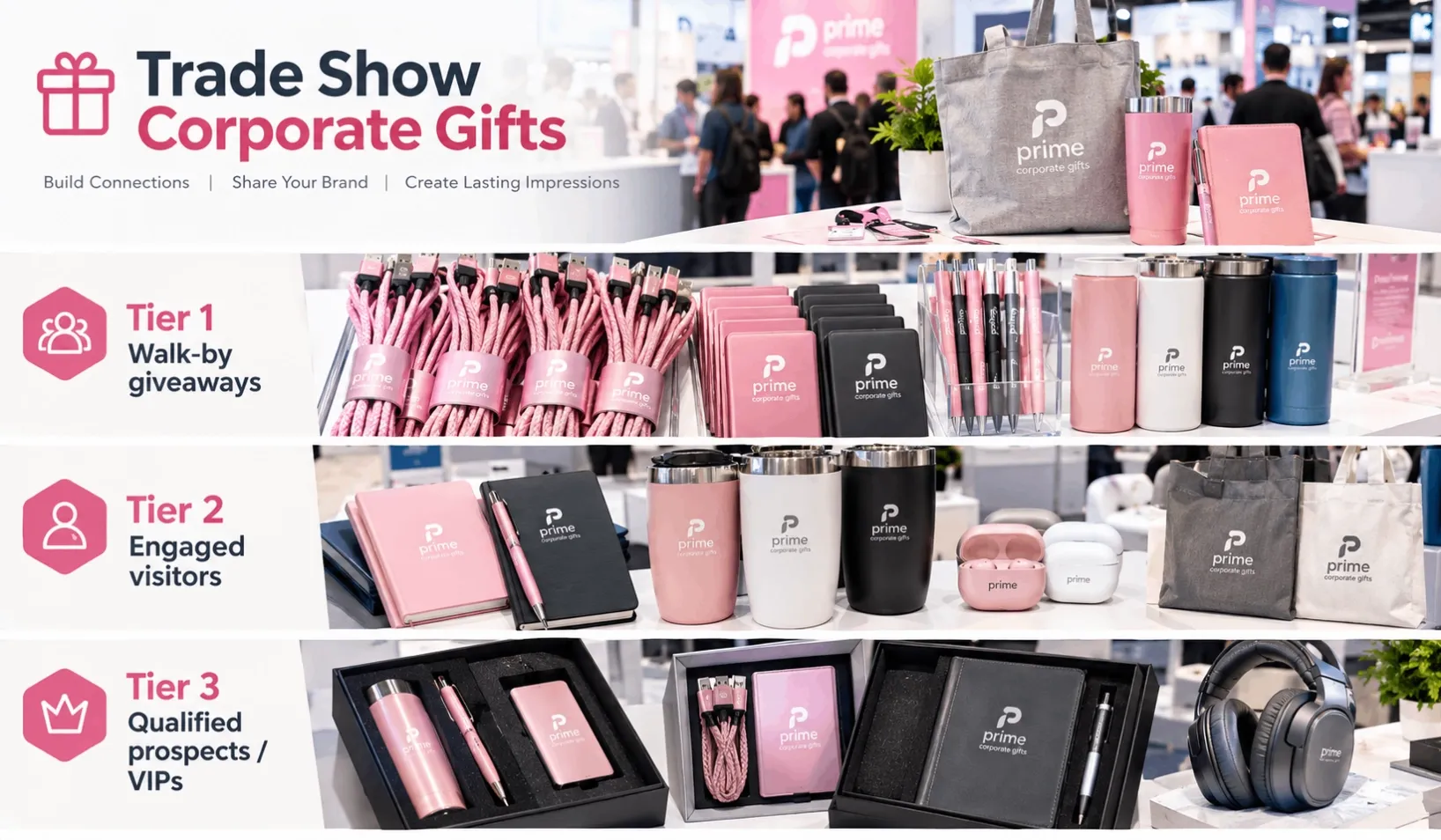
Trade show giveaways are a different product problem from corporate gifts — and judging them by the standards of a client gift is how companies waste budget on branded items that end up in the hotel room bin. A trade show gift has one primary job: to be worth carrying home, so your brand travels with it.
This guide covers how to choose, plan and budget trade show and event giveaways sourced from China: the tier structure, the categories that actually survive the show floor, quantity planning, and the timeline constraints that catch companies every season.
What Makes a Trade Show Giveaway Different
Four conditions separate event giveaways from other corporate gifts:
- Recipients self-select by value. Attendees judge instantly whether an item is worth carrying. A heavy, bulky or cheap-feeling item gets left behind; a useful or attractive one gets kept and carried — which is the entire objective.
- Quantity is large and uncertain. You need hundreds (or thousands) on hand, and there is usually waste on the last day when attendance or interest exceeds or falls short of the plan.
- Unit economics rule. At event volumes, a $0.30 cost difference per unit is a four-figure budget difference. The hierarchy of needs: useful, compact, good logo reproduction, durable enough to last past the show.
- Distribution logistics matter. Someone has to transport boxes to the venue, stock the booth, and manage giveaways across days. Packaging designed for shipping to a warehouse is not always right for a booth.
The Three-Tier Structure That Works
The most reliable trade show strategy is not one giveaway but a tiered program — the same principle as lead qualification, applied to swag:
Tier | Purpose | Budget Per Unit | Typical Categories |
|---|---|---|---|
Tier 1: Walk-by giveaways | Everyone who passes the booth; brand visibility at volume | Low (volume economics) | Pens, tote bags, bottle openers, stickers, cable organizers, lip balm |
Tier 2: Engaged visitors | People who stop, talk, or leave details; a "thank you" with substance | Mid tier | Notebooks, drinkware (bottles, tumblers), power banks, tote bags (quality), umbrellas, tech accessories |
Tier 3: Qualified prospects / VIPs | Booked meetings, partners, high-value conversations | Premium | Gift sets (notebook + pen + tumbler), premium drinkware, branded backpacks, leather items |
Two structural notes. First, tier quantity ratios usually look like roughly 10:3:1 (walk-by : engaged : VIP) — adjust to your booth traffic, but keep the top tier generous enough that the team can offer it without hesitation. Second, keep one visual family across tiers (same logo treatment, complementary colors) so the program reads as one brand rather than three unrelated orders.
Categories That Actually Survive the Show Floor
Based on what attendees consistently keep and reuse, these categories reliably earn their cost:
Highest Reliability
- Tote bags — the single best walk-by item, because attendees need a bag to carry everything else they collect. Choose a practical weight (not too thin), a neutral color, and a one-color logo for cost and clarity. Recycled cotton or nonwoven options are increasingly expected at European events.
- Drinkware: bottles and tumblers — high keep-rate, high usage frequency, strong logo presence. Stainless steel vacuum items drive perceived value well above their cost. Consider size and weight for travelers.
- Pens — still effective at volume, but only if the pen writes well and looks better than a hotel pen. A metal-bodied pen elevates the perception dramatically versus a plastic one, at modest cost difference.
- Notebooks — high utility for business events; hardcover with an elastic closure is the standard perception setter.
Strong With Specific Audiences
- Power banks / chargers / cable organizers — powerful for tech, engineering and B2B software audiences; attendees actually use them. Mind certification requirements for your market and battery shipping rules.
- Umbrellas — seasonal, geography-dependent, but a classic for outdoor or travel-related shows.
- Insulated travel mugs / thermos bottles — strong for construction, manufacturing and outdoor industries.
- Reusable straws / eco kits — fit sustainability-positioned brands and environmental events.
Categories That Usually Disappoint
- Anything that requires the attendee to think about it. Complex gadgets with unclear use get left behind; simple and immediately useful wins.
- Very cheap plastic items with weak construction. They read as "conference trash" and devalue the brand rather than spreading it.
- Items too large or heavy to carry through a show floor. Attendees walk for hours; anything bulky gets abandoned or resented.
- Apparel at unknown sizing. Unless you have size data, apparel at trade shows means guessed sizes and pile leftovers — reserves for pre-registered, sized programs.
Quantity Planning for Events
Event quantity planning follows a simple model with a deliberate waste allowance:
- Booth traffic estimate: attendees expected × proportion likely to visit your booth category. For first-time exhibitors, plan conservatively (a few percent of total attendance is a common starting assumption; ask the organizer for visitor-flow data).
- Giveaway rate: not every booth visitor takes a Tier 1 item; plan on a proportion (often 50–70%) rather than assuming one per visitor.
- Rush-day adjustment: the final day often brings heavier walk-by traffic; plan the closing-day quantities separately rather than spreading evenly.
- Buffer: add 10–15% buffer for Tier 1 items. Leftover branded stock keeps for the next event (so plan products with a long shelf life — avoid anything dated or event-specific); running out during the show cannot be fixed.
One useful discipline: set a per-cover giveaway budget (the expected cost of giveaways per qualified conversation, not per attendee) and measure the program against it. It keeps the tier mix honest — too much Tier 1 volume or too many Tier 3 items both blow the ratio.
Logo and Customization Notes for Event Items
- Logo size matters more at events. A small logo lost on a large tote bag communicates less; size the logo to read from a meter or two away. One-color, large, clean logos still read best.
- One-color artwork keeps costs down and simplifies reproduction across a category mix (bags, drinkware, notebooks). Reserve multi-color for the premium tier. Our guide to logo printing methods covers the trade-offs.
- Packaging should be leave-behind friendly. Booth giveaways often skip individual retail boxes in favor of bulk packing for easy booth storage — decide this consciously rather than accepting the default.
- Consider carry-away practicality in the design. Flat-packing bags and boxes are easier to ship to the venue and store at the booth than rigid presentations.
Timeline: Book Before the Crunch
Event giveaway programs run on hard deadlines, and the production calendar does not bend:
- Standard logo items (bags, pens, notebooks): 4–6 weeks total including production and air freight.
- Drinkware and tech items with customization: 5–8 weeks.
- Gift sets or multi-item packaging: 8–12 weeks.
- Add 1–2 weeks: if the event falls near Chinese New Year or in the Q4 peak, or if your internal approval process adds days.
Practically: book trade show giveaways 3–4 months before the event, especially for anything beyond simple print — that is the window where you have choices (shipping method, sample pace, product availability) instead of only remedies. Our guide to corporate gift lead times breaks the timeline into its segments.
Frequently Asked Questions
What are the best trade show giveaways?
The most reliably kept categories are tote bags, quality drinkware (bottles and tumblers), notebooks and good pens, with power banks and tech accessories strong for tech audiences. The pattern behind them: attendees keep what they need or want to carry, so useful items with clear branding and durable feel win. Avoid bulky, fragile, complicated or very cheap plastic items — they read as conference trash and get abandoned.
How many giveaways do I need for a trade show?
Estimate booth visitors (attendees × your booth's likely visit rate), multiply by a 50–70% take rate for Tier 1 items, and add a 10–15% buffer. Plan the final day separately since walk-by traffic often rises. Whatever your total, keep tier ratios so the premium items stay genuinely premium rather than being depleted early.
How much should trade show giveaways cost per item?
Typical practice uses a tier structure: low-cost items (bags, pens) at volume, mid-tier items (notebooks, basic drinkware) for engaged visitors, and premium items (sets, premium drinkware) for qualified prospects. Rather than an absolute per-item budget, set a cost-per-qualified-conversation target and build the tier mix to hit it. That keeps overall spend tied to outcomes instead of item count.
Should giveaways be branded with a large logo?
At events, yes — a logo sized to read from a normal conversation distance works better than a small subtle mark, because the item is the brand's representative when the attendee takes it home. One-color, high-contrast logos keep the cost low and the readability high. Save elaborate multi-color treatments for the premium tier where unit quantities are small.
When should I order trade show giveaways?
Three to four months before the event for anything involving more than simple printing, and at least six weeks before the event even for simple items with express shipping. Event programs that start late lose options in a fixed order: first the choice of shipping (forced to air express), then the sample round (forced to skip), then product choice (forced to stock-only). Starting early is the only way to keep all three.
Next Step
Trade show giveaways come down to four decisions: a tiered structure matched to visitor types, categories that survive the show floor, quantities planned with a buffer, and a timeline booked three to four months ahead.
If you have an upcoming event, send us the show details, expected attendance and budget — we will propose a tier structure and product mix that fits, confirm the timeline from your date, and coordinate production and delivery to your venue. You can also browse our product categories for giveaway options by tier.